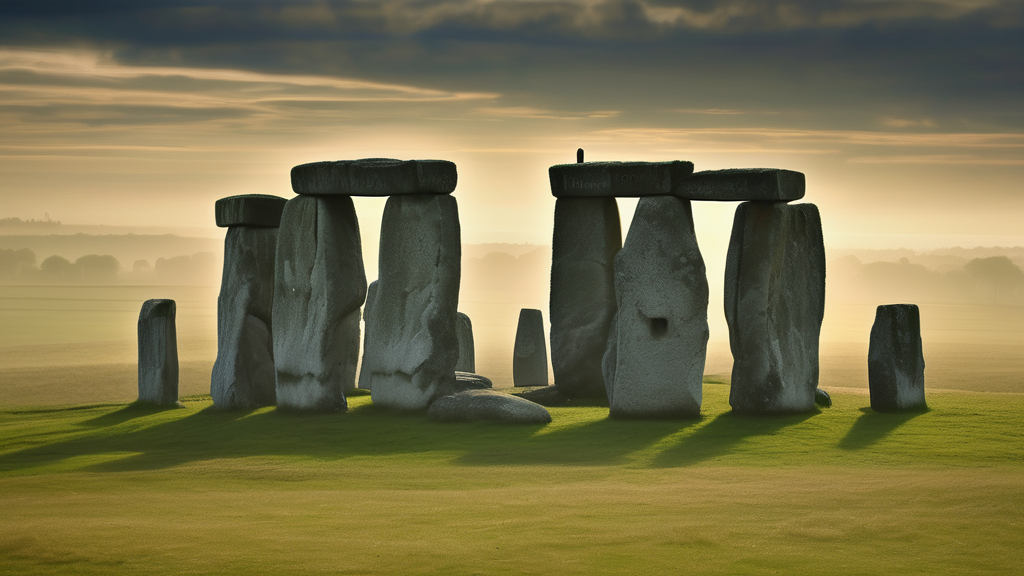
Three miles down the road from the most famous prehistoric monument on Earth, archaeologists have stumbled across something that might just rewrite the opening chapter of Stonehenge’s story.
The newly discovered structure, located near Amesbury in Wiltshire, is far simpler than its iconic neighbour. Just two upright timber posts, planted into the earth around 5,000 years ago. But here’s what makes it extraordinary: those two posts were deliberately aligned with the summer and winter solstices, the same astronomical logic that underpins Stonehenge itself.
In other words, someone was tracking the sun in this landscape long before the great stones were ever dragged across Salisbury Plain.
Researchers believe the timber structure represents an early, stripped-back form of solstice monument, essentially a prototype for the architectural ambitions that would eventually produce Stonehenge. The find suggests the obsession with solar alignment in this corner of Wiltshire didn’t begin with the famous stone circle. It was already baked into the land.
“What we’re seeing is a tradition that stretches back further than we previously appreciated,” one archaeologist involved in the project noted. The site appears to predate the earliest phases of Stonehenge construction, which began around 3000 BC.
The discovery was made during routine survey work in the area, which continues to yield surprises despite decades of intensive study. Modern ground-penetrating radar and LiDAR technology have transformed what researchers can detect without lifting a single turf, and sites like this one are increasingly coming to light as a result.
Two posts might sound modest compared to 25-tonne sarsen stones. But there’s something quietly compelling about the simplicity of it. Someone stood in a field five millennia ago, looked up at the sky, and decided to mark the moment the sun reached its furthest point. No grand architecture, no enormous labour force. Just timber, earth, and intention.
The landscape around Stonehenge has always been understood as a ceremonial complex rather than a single monument. This latest find deepens that picture considerably, suggesting the area was a sacred site in the making for far longer than the stones alone could tell us.
Whether further survey work will uncover more of these simpler precursor structures scattered across Wiltshire is the question archaeologists will now be asking rather urgently.